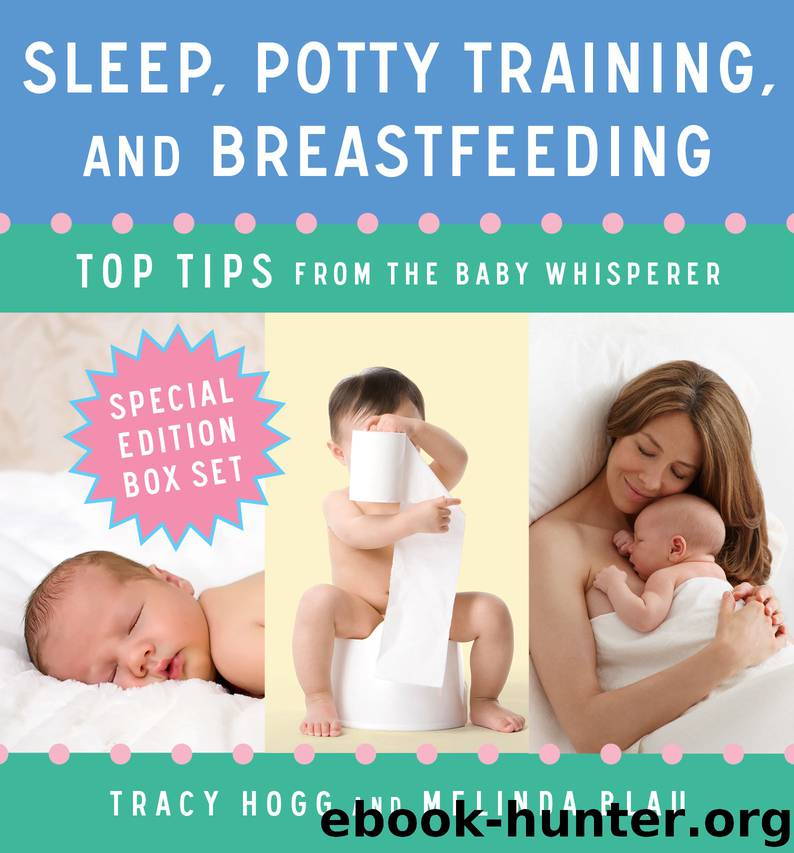
Sleep, Potty Training, and Breast-feeding by Tracy Hogg
Author:Tracy Hogg
Language: eng
Format: epub
Publisher: Atria Books
Why Nine Months?
Many of you are skeptical, if not shocked, when I suggest starting toilet training as early as nine months. So allow me to explain. At nine months, I view the process of elimination as part of a baby’s daily routine—a parent’s job is to make him conscious of it.
Just as there’s time for eating, activity and sleep, you also make time for elimination. Twenty minutes after your baby eats or drinks, you put him on the toilet. In effect, you’ve got him on an “E.E.A.S.Y.” routine—eat, elimination, activity, sleep, and time for you (which admittedly becomes less and less as your child approaches toddlerhood). The two “E”s in E.E.A.S.Y. are switched when your child gets up in the morning, because then you’ll put him on the toilet straightaway, before he eats (see “The Plan” in Chapter 3).
When you start training between nine months and a year, naturally, your baby doesn’t have the control or consciousness of an older child. Hence, toilet training is less about teaching your baby as much as about conditioning him.
By putting him on the toilet seat at times that he normally goes to the bathroom, or when he exhibits signs that he’s about to pee or poo (which is usually after he’s eaten), you’re likely to catch him, perhaps not every time but sometimes. He feels the toilet seat, and he learns to release his sphincter muscles. When he does, you cheer him on, just as you did when he started pulling himself upright. He’s at an age where he still wants to please you (which he most assuredly won’t want to do at around the age of two), and that positive reinforcement will help him realize that the accidental act of elimination is something you value.
By starting early, you’re also giving him practice in allowing his sphincter muscles to relax and to release his pee and poo into a receptacle rather than his diaper. And isn’t that what acquiring a skill is all about? Practice, practice, practice!
In contrast, when you wait until he’s two, he’s already accustomed to eliminating into a diaper, and he then has to learn not only to tune in to his own body signals but also to be willing to release his waste elsewhere. He’s also had no practice.
It would be like expecting a child to walk but keeping him in his crib in a sitting position until you thought it was “time” for him to do so. Without those months of trial and error, strengthening his legs, and learning how to coordinate his movements, he wouldn’t be very good on his feet, would he?
Download
This site does not store any files on its server. We only index and link to content provided by other sites. Please contact the content providers to delete copyright contents if any and email us, we'll remove relevant links or contents immediately.
Doing It: Let's Talk About Sex... by Hannah Witton(9326)
Thirteen Reasons Why by Jay Asher(9011)
The Girl Without a Voice by Casey Watson(7929)
The Incest Diary by Anonymous(7765)
Should I Stay or Should I Go? by Ramani Durvasula(7728)
The Lost Art of Listening by Michael P. Nichols(7555)
The Leavers by Lisa Ko(7000)
The Testaments by Margaret Atwood(6990)
The Space Between by Michelle L. Teichman(6980)
The Four Agreements by Don Miguel Ruiz(6841)
Rich Dad Poor Dad by Robert T. Kiyosaki(6736)
The Rosie Project by Graeme Simsion(6529)
Beartown by Fredrik Backman(5858)
We Need to Talk by Celeste Headlee(5674)
Ego Is the Enemy by Ryan Holiday(5533)
Men In Love by Nancy Friday(5309)
Spare by Prince Harry The Duke of Sussex(5267)
Hunger by Roxane Gay(4979)
Suicide Notes by Michael Thomas Ford(4871)
